
Personal electric aircraft have teased us for years. They look futuristic, promise freedom from traffic, and usually come with prices that put them out of reach or timelines that feel uncertain. Recently unveiled at CES 2026, the Rictor X4 entered that conversation with some bold claims.
It is a single-passenger electric vertical takeoff and landing aircraft designed to make short-range personal flight more accessible and far more affordable. If those promises hold up, it could change how we think about flying for everyday trips.
Sign up for my FREE CyberGuy Report Get my best tech tips, urgent security alerts and exclusive deals delivered straight to your inbox. Plus, you’ll get instant access to my Ultimate Scam Survival Guide — free when you join my CYBERGUY.COM newsletter

CES 2026 put health tech front and center, with companies showcasing smarter ways to support prevention, mobility and long-term wellness. (CES)
TECH STARTUP, MAJOR AIRLINE PARTNER TO LAUNCH ELECTRIC AIR TAXI SERVICE
What the Rictor X4 actually is
The Rictor X4 uses a multirotor design with eight propellers spread across four carbon fiber arms. Those arms fold inward when the aircraft is not in use, allowing it to fit in the bed of a pickup truck. The aircraft focuses on low-altitude flight and short hops rather than long journeys.
Key specs include:
- Top speed of about 50 mph
- Maximum flight time of 20 minutes
- Payload capacity of up to 220 pounds, including the pilot
It can lift off and land vertically like a helicopter, then transition into forward flight once airborne. Rictor describes its mission as light aerial mobility, which essentially means short-distance commuting and professional applications.
Inside the X4’s propulsion and power system
According to Rictor, the X4’s propulsion system is built around stability and redundancy rather than raw speed. Each axis uses a coaxial dual-motor configuration designed to provide consistent thrust during low-altitude flight.
Key propulsion details include:
- Rated thrust of up to 165 pounds per axis
- Peak thrust exceeding 285 pounds per axis
- Maximum continuous power output of 10 kW
- 120-volt operating system designed for outdoor conditions
Together, these systems aim to deliver controlled, predictable flight with built-in safety margins, especially during takeoff, landing, and hover.
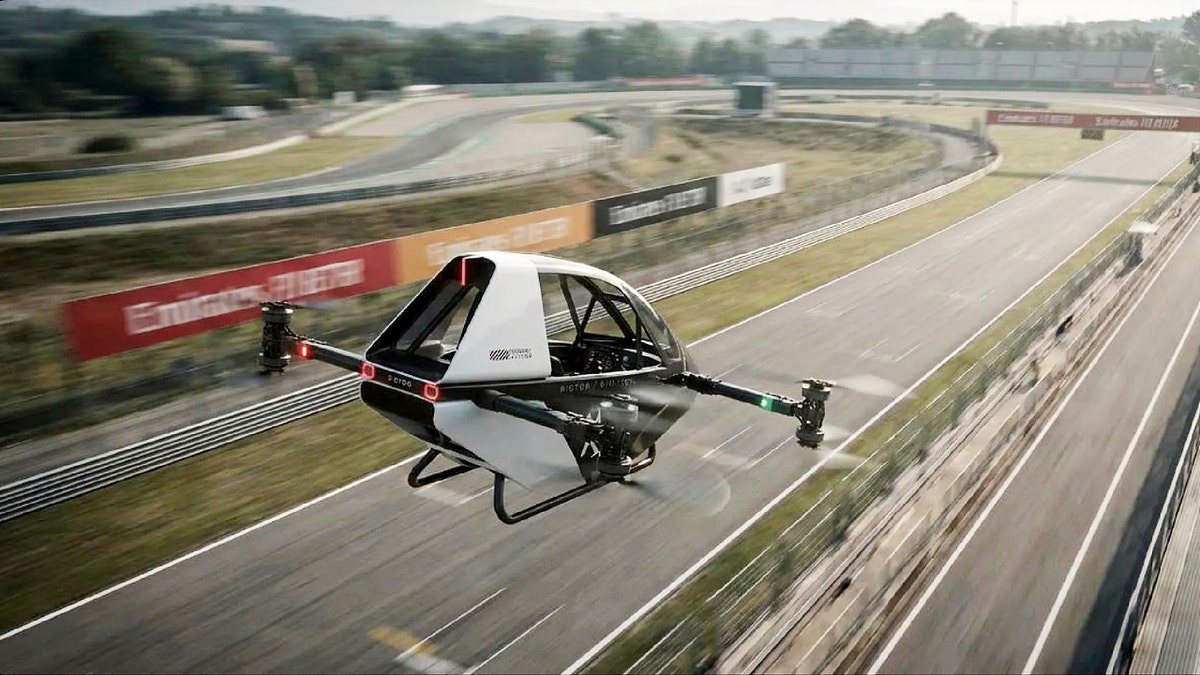
The Rictor X4 is a single-passenger electric aircraft designed for short-range, low-altitude flight with a folding multirotor layout. (Rictor)
Safety systems and flight control in the Rictor X4
Rictor puts safety at the center of the X4’s design. The aircraft uses a semi-solid state battery system with dual battery redundancy, which helps enable a controlled landing if one battery module fails. In addition, an emergency parachute system provides backup protection during critical situations. At the same time, a centralized flight control system actively manages propulsion, attitude, and overall system health. This system continuously monitors key flight data to help maintain stability in changing conditions.
Beyond software, the hardware plays an important role. The X4 features 63-inch carbon fiber folding propellers in a 4-axis, 8-propeller configuration. Together, they support a payload of up to 220 pounds, including the pilot. According to Rictor, the aircraft is designed to operate at noise levels below 65 decibels, although independent testing has not yet been published. Finally, Rictor’s proprietary Dynamic Balance Algorithm adjusts the output of all eight motors in real time. As a result, the X4 can maintain a stable hover even in side winds rated up to Level 6.
The FAA rule that could make personal flight easier
One of Rictor’s most attention-grabbing claims involves regulation. The company says the X4 is designed to comply with FAA Part 103, which governs ultralight vehicles in the US. If operated within Part 103 limits, the X4 could be flown legally without airworthiness certification or a pilot’s license. Rictor says this is enabled by autonomous pre-programmed flight paths and very low altitude operation, reportedly as low as three meters above ground. It is worth noting that Part 103 still carries operational restrictions, including where and how flight can occur. Final compliance depends on real-world use and FAA interpretation.
Designed to fold, transport, and recharge
Portability is a major focus. Rictor says the X4 folds down to about 42 cubic feet, which makes it compact enough to transport in the bed of a pickup truck. The company also highlights in-vehicle charging support while parked or on the move, positioning the X4 as something that can be transported and recharged alongside ground vehicles rather than stored at an airfield.
AIR TAXI SERVICE PLANS EVTOL RIDES FROM ALL THREE NYC AIRPORTS
The price that resets expectations
The Rictor X4 carries a launch price of $39,900 with a $5,000 deposit. That alone separates it from most personal eVTOLs currently discussed in the market. The aircraft is produced by Kuickwheel Technology, Rictor’s parent company. According to the company, first customer deliveries are scheduled for Q2 2026. As with any aircraft launch, timelines remain aspirational until production units reach customers.
Why this matters now
Personal eVTOLs have lived in a narrow space between concept and reality. High costs, regulatory hurdles, and safety concerns have slowed adoption. If Rictor delivers an aircraft that performs as described while operating within ultralight rules, it could expand personal flight beyond niche enthusiasts and into practical short-range use. Now it comes down to whether the company can deliver on what it’s promising.
Take my quiz: How safe is your online security?
Think your devices and data are truly protected? Take this quick quiz to see where your digital habits stand. From passwords to Wi-Fi settings, you’ll get a personalized breakdown of what you’re doing right and what needs improvement. Take my Quiz here: Cyberguy.com
Kurt’s key takeaways
The Rictor X4 brings together aggressive pricing, compact design, and regulatory positioning in a way we have not seen before. Folding propellers, redundant safety systems, and Part 103 alignment make it one of the most ambitious personal eVTOL launches to date. The unanswered questions center on real-world performance, regulatory interpretation, and production readiness. Until aircraft are flying outside controlled demonstrations, healthy skepticism remains warranted. Still, this is one of the most compelling personal flight announcements to come out of CES in recent years.
Would you trust a personal eVTOL like this for everyday trips, or does flight still feel like a step too far for now? Let us know by writing to us at Cyberguy.com
CLICK HERE TO DOWNLOAD THE FOX NEWS APP
Sign up for my FREE CyberGuy Report Get my best tech tips, urgent security alerts and exclusive deals delivered straight to your inbox. Plus, you’ll get instant access to my Ultimate Scam Survival Guide — free when you join my CYBERGUY.COM newsletter
Copyright 2026 CyberGuy.com. All rights reserved.